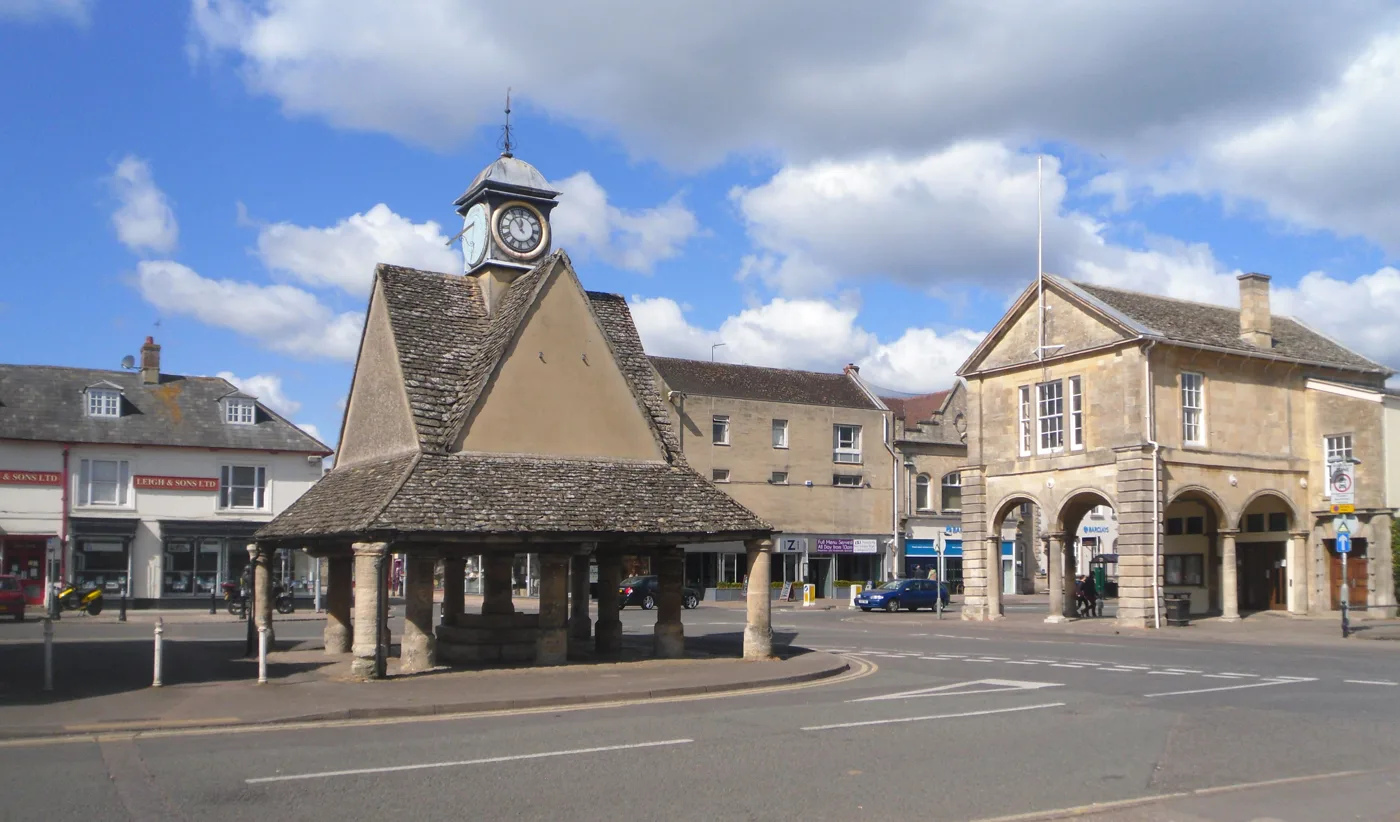
Band D in Witney is £2,652.79, the highest of any parish in West Oxfordshire. The full A to H table, what each precept takes, and who pays £213 less.
A Band D property in Witney pays £2,652.79 in council tax this year, the highest figure of any parish in West Oxfordshire. Eighteen parishes in the same district pay £2,439.44 for identical services, a gap of £213.35.
The reason is the town council precept, which is the only part of the bill decided in Witney. West Oxfordshire District Council publishes the full A to H table for all 81 parishes, but only as a PDF, and nowhere on that PDF does it say which parish is dearest. Below is Witney’s table, the same for the district’s other towns, and the arithmetic behind them.
Witney council tax bands 2026/27
| Band | Property value on 1 April 1991 | Charge for the year |
|---|---|---|
| A | Up to £40,000 | £1,768.52 |
| B | £40,001 to £52,000 | £2,063.29 |
| C | £52,001 to £68,000 | £2,358.03 |
| D | £68,001 to £88,000 | £2,652.79 |
| E | £88,001 to £120,000 | £3,242.29 |
| F | £120,001 to £160,000 | £3,831.80 |
| G | £160,001 to £320,000 | £4,421.31 |
| H | Over £320,000 | £5,305.58 |
Source: West Oxfordshire District Council, council tax charges 2026 to 2027, published 5 March 2026.
Those 1991 values are not a typo. Every band in England still rests on what the property was worth on 1 April 1991, and there has never been a revaluation.
The rest of the district’s towns
| Parish | Band A | Band D |
|---|---|---|
| Witney | £1,768.52 | £2,652.79 |
| Chipping Norton | £1,743.96 | £2,615.95 |
| Burford | £1,738.44 | £2,607.67 |
| Eynsham | £1,737.39 | £2,606.09 |
| Bampton | £1,715.33 | £2,573.00 |
| Carterton | £1,711.87 | £2,567.81 |
| Charlbury | £1,696.66 | £2,544.99 |
| Hanborough | £1,681.30 | £2,521.95 |
| Woodstock | £1,681.09 | £2,521.64 |
| Ducklington | £1,673.80 | £2,510.70 |
| Parishes with no precept | £1,626.29 | £2,439.44 |
Source: the same council charges PDF. Every parish in the district is on it.
Where the money goes
Only 5.07 pence in every pound of a Witney bill stays with West Oxfordshire District Council. Just over 75 pence goes to the county.
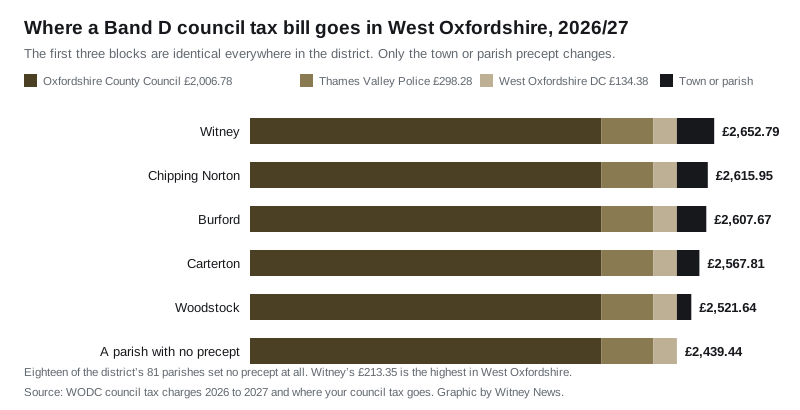
| Who | Band D charge | Share of a Witney bill | Change this year |
|---|---|---|---|
| Oxfordshire County Council | £2,006.78 | 75.65% | up 4.99% |
| Thames Valley Police and Crime Commissioner | £298.28 | 11.24% | up £15.00, or 5.30% |
| Witney Town Council | £213.35 | 8.04% | up £9.98 |
| West Oxfordshire District Council | £134.38 | 5.07% | up £5.00 |
| Total | £2,652.79 |
Source: West Oxfordshire District Council, where your council tax goes. The county, police and district figures are identical everywhere in the district. Only the fourth line changes.
There is no separate fire precept in Oxfordshire. Fire and rescue is run by the county council and is inside its £2,006.78.
The county council is the increase. Oxfordshire took 4.99 per cent, the maximum allowed without a referendum: 2.99 per cent general and 2 per cent adult social care precept. Its cabinet member for finance, Cllr Dan Levy, was blunt in January about why. The government cut grant funding and assumed the council would make up the difference, he said, so “we will have to put up Council Tax by 4.99% each year, but a lot of this money will immediately be subtracted by the government and sent elsewhere”. The county faces a further £14m of savings in 2027/28.
The police added £15. The Police and Crime Commissioner’s own council tax leaflet puts it as “£15 a year or 29p per week for a Band D household”. Thames Valley Police’s net revenue budget for 2026/27 is £622m, up £27m or 4.5 per cent.
The district added £5, which it describes as around 10p a week. Its total budget for the year is £18.4m, of which £6.7m comes from council tax and £8.3m from government grants. It also froze the garden waste charge at £52.50, which it says makes it the lowest-charging council in Oxfordshire for that service.
Witney Town Council added £9.98. Councillors approved the precept on 2 February 2026, taking the Band D contribution to £213.35. The town council says that is 8 per cent of the total bill and pays for parks, cemeteries, verges, sports pitches, the wheeled sports park, the Corn Exchange, the lake and country park, allotments, Christmas lights, the town bus service and The Station youth work.
Why your neighbours pay less
The gap between the dearest and cheapest parish in West Oxfordshire is £213.35 a year at Band D, for the same county, police and district services.
- Witney is the most expensive at £2,652.79, followed by Ramsden at £2,630.46 and Leafield at £2,623.45.
- Eighteen of the 81 parishes set no precept at all and pay £2,439.44: Blenheim, Bruern, Cornbury and Wychwood, Cornwell, Fawler, Glympton, Grafton and Radcot, Hardwick and Yelford, Holwell, Idbury, Kelmscott, Kencot, Kiddington with Asterleigh, Little Faringdon, Lyneham, Rousham, Westwell and Worton.
- The district-wide average parish element is £127.51 at Band D. Witney’s is £213.35, well above it.
Checking and challenging your band
Your band is on your bill. If you do not have it, the Valuation Office Agency publishes the band for every address in England, and the same service takes challenges.
The VOA sets bands, not the council. Keep paying at your current band while a challenge is considered. West Oxfordshire is explicit that nothing is suspended while you wait; a successful challenge is refunded afterwards. Its bands and appeals page links straight through.
A dispute about liability rather than valuation is a different route. That goes to the council first, then to the independent Valuation Tribunal.
Discounts, and the one most people miss
Single person discount: 25 per cent. A full bill assumes two adults living in the property as their main home.
Some adults are not counted at all, which can take a household below two even when more people live there. The list includes full-time students, student nurses, school and college leavers under 20 still attracting child benefit, people caring for an elderly or disabled person they live with, people who are severely mentally impaired, and members of religious communities. A property occupied only by students is exempt.
A disabled band reduction moves you down a band. If someone in the household is disabled and the property has an extra bathroom, an extra kitchen, another room they need, or space for a wheelchair indoors, the bill is charged at the band below. In Band A the reduction is one sixth.
Section 13A reductions exist for sudden hardship. The council can write off part of a bill in exceptional circumstances at its own discretion and out of its own funds. The policy and form are on its discounts page. It is not advertised on the bill.
Council Tax Support pays 100 per cent for the lowest incomes
West Oxfordshire’s working-age scheme is banded by income, and unlike many councils’ schemes it has no floor that leaves everyone paying something.
| Weekly income | Reduction |
|---|---|
| £0 to £143.04 | 100% |
| £143.05 to £203.04 | 80% |
| £203.05 to £258.04 | 60% |
| £258.05 to £313.04 | 40% |
| £313.05 to £368.04 | 20% |
Source: West Oxfordshire District Council, Council Tax Support scheme for working age customers 2026 to 2027. Thresholds are higher for couples and for households with children.
Two conditions are worth reading before you apply.
- Support in a Band F, G or H home is capped at the Band E charge. The scheme restricts the annual liability used in the calculation.
- Evidence must arrive within one calendar month of the application or the claim is treated as defective. The council aims to decide complete claims in 14 days.
There is also an Exceptional Hardship Fund for people already on Council Tax Support who still cannot pay.
Empty homes and second homes
The premiums are steep and they are cumulative with the ordinary charge.
- Empty and unfurnished for 1 to 5 years: 100 per cent premium.
- 5 to 10 years: 200 per cent premium.
- 10 years or more: 300 per cent premium.
- Second homes: furnished but nobody’s main home, 100 per cent premium since 1 April 2025. No discount applies either way.
Exceptions exist and several are time-limited to 12 months: a property being actively marketed for sale or to let, one awaiting probate, one undergoing major repairs, an annexe, and job-related or armed forces accommodation. The full class lists are on the council’s long-term empty properties and second homes pages.
Have your say